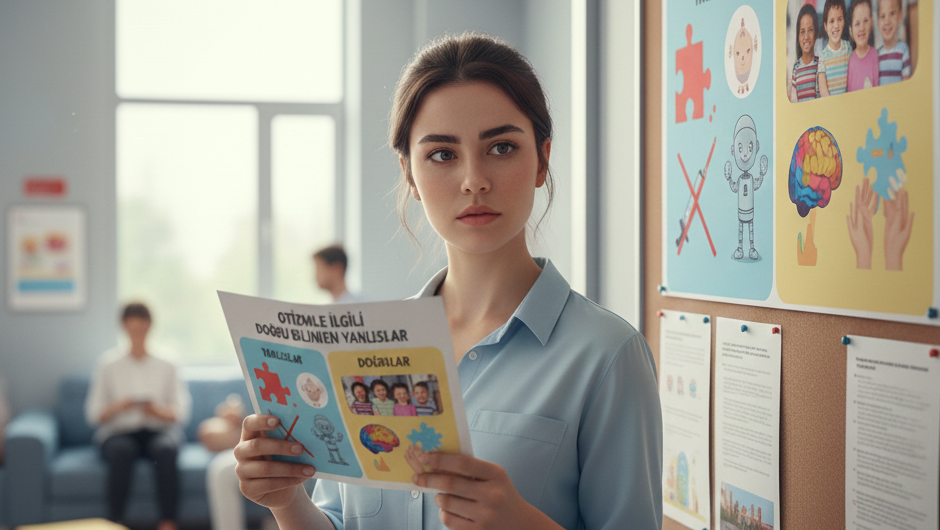
Common Misconceptions
Autism spectrum disorder is both perceived differently in our country and is also misunderstood. You can find the known and unknown facts about autism in this section.
False: Vaccines cause autism.
True: In numerous studies examining the relationship between vaccinations and autism, no significant association was found between childhood vaccinations and the likelihood of developing autism. On the other hand, vaccination is a practice that significantly improves public health in terms of childhood diseases, and as the prevalence of vaccination increases, there is a reduction in childhood diseases in children, or even if the disease occurs, a mildening of the course of the disease. In cases where vaccination is refused, it is stated that children are at a greater risk of autism, and are at a higher risk of death. Autism – Click for the Information Note on the Relationship between Vaccines.
Incorrect: The autism diagnosis is made only after the age of 3.
Autism is a neuro-developmental difference that is congenital and usually appears in the first years of life. With careful observation and assessment, autism symptoms can be noticed in children starting from 6-12 months of age. Today, with the recognition of the symptoms, an autism diagnosis can be made, while the most appropriate time for diagnosis is between 18 months and beyond.
False: Even individuals with autism are highly intelligent.
Doğru: Her birey otizmden farklı düzeylerde etkilenmektedir. Bazı otizmli bireyler güçlü bir hafızaya ya da resim yapmak gibi farklı ve sıradışı yeteneklere sahip olabilirler. Bu tür üstün yeteneklerin olması durumunda kişiye savant otizmli denilmektedir ve bu durum otizm popülasyonunda her 10 bireyden 1’inde (1:10) görülmektedir. Ancak otizmli bireylerin çoğu bu yeteneklere sahip değildir. Bununla birlikte otizmli bireylerin %55’ine farklı düzeylerde zihin yetersizliği eşlik etmektedir.
Incorrect: The indifferent behavior of parents causes autism.
True: Autism is a neuro-developmental difference that is present at birth. Environmental factors that occur after birth, such as the unconcerned behavior of the parents, do not directly cause autism..
Incorrect: Their external appearances are all the same.
True: Autism is not a difference distinguished by physical characteristics; all children with autism have different physical characteristics.
Wrong: They are all highly skilled.
Doğru: Otizm spektrum bozukluğu tanılı bireylerin pek azında (yaklaşık %10) çok güçlü bellek, müzik yeteneği vb. üstün yeteneklere rastlanır. Click here for information about Savant Syndrome.
Incorrect: They do not have conversational skills.
True: The speech abilities of individuals with autism vary from person to person. Some individuals with autism may speak fluently, while others have a limited vocabulary or may not be able to speak at all. Speech abilities can vary depending on how much the individual is affected by autism and whether they receive support through early intervention.
Incorrect: They are similar to children with Down syndrome.
True: Autism and Down Syndrome are quite different from each other.
False: The cause of autism is inbreeding.
True: Although the cause of autism is still unknown today, the prevailing view is that it may have genetic and environmental roots. Inbreeding can cause some recessive genes to become dominant.
Wrong: They get better with medication.
True: The only effective treatment for autism is early intervention and intensive, sustained education. Medications do not treat the core symptoms of autism; however, they can be used as supportive measures in managing conditions such as accompanying attention deficit, hyperactivity, anxiety, or sleep problems.
Wrong: Autistic people are “Rain Man”.
True: Autism affects each individual at different levels. Some autistics may possess strong memories or extraordinary abilities in certain areas, while others may require more support in communication, social interaction, and daily living skills. The film “Rain Man” presents a story that focuses solely on a specific aspect of autism and is not a general representation of autism.
Incorrect: Autism is an intestinal disease.
True: Autism spectrum disorder is a neurodevelopmental difference that is present at birth. Some individuals with autism may experience digestive problems; however, this is considered a concomitant health problem, not the cause of autism.
False: Autism is caused by a cold parenting style.
True: The ’fridge mom“ assumption, which was proposed for mothers lacking emotional closeness in the 1950s, has been debunked many years ago. Contrary to this assumption, autism is a neurodevelopmental disorder and has been scientifically proven to result from the interaction of genetic and environmental factors.
False: Autism is a disease and it can be cured.
True: Autism is not a disease; it is a lifelong neuro-developmental difference. With early intervention and appropriate education, individuals with autism can make significant progress, but this is not described as a “cure.” Individuals with autism can be supported throughout their lives to have different needs and abilities.
False: Individuals with autism do not feel pain.
True: Individuals with autism spectrum disorder may have high or low sensitivity to sensory stimuli.
False: Autism is a condition that can be cured with short-term training.
True: Autism is often a lifelong neuro-developmental difference. With intensive and effective education initiated early on, individuals can improve their quality of life and skills. The duration of this education can vary depending on how much support the individual may need in their life and how much they are affected by autism.
Incorrect: Autistic children do not like to be hugged.
True: The preferences of children with autism regarding physical touch are individual; some like to be hugged, while others may prefer to show affection in different ways. What matters is establishing a safe and supportive communication by respecting their boundaries.
Wrong: If he is looking at moving objects, he is definitely autistic.
True: Repetitive behaviors can be seen as a developmental stage in many children, but simply being interested in repetitive behaviors is not enough to say that a child is autistic. A diagnosis of autism can only be made through expert evaluation and a comprehensive examination of the differences in multiple areas such as communication and social interaction.
False: Autism improves with diet.
True: Diets can help support the health status of some individuals with autism. However, diets do not cure or treat autism. The only treatment for autism is early and intensive education. Scientifically based educational and therapeutic approaches are the most effective methods for the development of individuals with autism.
False: Autistic people don't live very long.
True: Autism is not a condition that shortens life expectancy. The life expectancy of individuals with autism is a subject of misunderstanding in society; most individuals with autism can lead healthy lives and with appropriate support, quality of life can be improved.
False: Autistic children are aggressive.
True: Autistic children are not aggressive; however, due to communication difficulties or sensory sensitivities, they may sometimes react in different ways. An approach to understanding them and professional support play a key role in preventing such situations. However, autistic individuals are at risk of being deliberately subjected to violence.
False: Autism is caused by trauma.
True: Autism is a neurodevelopmental difference that is present at birth, and post-traumatic events such as trauma do not cause autism. However, individuals with autism can experience trauma just like everyone else, so it is important to pay attention to their emotional and psychological well-being.
Incorrect: The cause of autism is the working mother.
True: Autism is a genetically determined difference and is thought to be the result of environmental factors.
False: Autism is contagious.
True: Autism is not an infectious disease; it is a neurodevelopmental difference that develops as a result of the interaction of genetic factors and environmental factors. Each individual's experience of autism is different, and this does not pass from person to person.
False: Autistic people have cognitive disabilities.
True: Autism manifests itself as impairments in communication and social interaction skills, repetitive movements, and limited/intense interests. More than half of individuals with autism also exhibit various cognitive problems.
False: The cause of autism is excessive television watching.
True: Autism is a neuro-developmental difference that is present from birth and in the first years of life. Time spent with phones, tablets, computers, and televisions is not the direct cause of autism. Screen time does not cause autism, but exposure to screens can increase a child's autism severity.
Incorrect: Autistic people are hyperactive.
True: Alanyazında contains important findings that autism spectrum disorders and attention deficit hyperactivity disorder (ADHD) are co-occurring (comorbid). However, not every autistic person is hyperactive. The behaviors and energy levels of autistic individuals can vary greatly. Although attention deficit and hyperactivity are seen in some autistic individuals, this is not true for all autistic individuals. Each individual's characteristics are unique, and therefore generalizing can be misleading.
Incorrect: Asperger's people have superior abilities.
True: Individuals with Asperger syndrome may be obsessive about certain special topics such as music or historical meteorology, but in general they do not have higher IQ scores than normal people.
False: Autism is a trait that runs in families.
True: It is believed that autism is caused by genetic and environmental factors.