
Applied Behavior Analysis
Discrete Trial Teaching
Discrete Trial Training, also known as the Lovaas method, is the presentation of many teaching presentations one after another in a one-on-one teaching session. In these presentations, a question, instruction, or material is directed at the child, and a response is expected from the child in return. While correct responses from the child are reinforced, incorrect responses are ignored or corrected. In practice, the arrangements to be made before the behavior (e.g., preparing materials) and after the behavior (e.g., collecting data) are systematically planned and implemented. With this system, various skills from many developmental domains can be taught to children with autism. Discrete Trial Training can be used together with other practices such as prompting and reinforcement strategies, task analysis, and time delay instruction. The effectiveness of Discrete Trial Training in acquiring critical skill areas for children with autism, such as imitation, matching and classification, receptive language, play, and self-help skills, has been demonstrated by various studies.
Source Recommendations:
- Steinbrenner, J. R., Hume, K., Odom, S. L., Morin, K. L., Nowell, S. W., Tomaszewski, B., Szendrey, S., McIntyre, N. S., Yücesoy-Özkan, S., & Savage, M. N. (2020). Evidence-based practices for children, youth, and young adults with Autism. The University of North Carolina at Chapel Hill, Frank Porter Graham Child Development Institute, National Clearinghouse on Autism Evidence and Practice Review Team.
- https://asatonline.org/for-parents/learn-more-about-specific-treatments/applied-behavior-analysisaba/aba-techniques/discrete-trial-instruction/
- https://www.tohumotizmportali.org/egitimler/davranislari-yonetmek/yeni-davranislar-kazandirma/eszamanli-ipucuyla-ogretim
- https://www.tohumotizmportali.org/egitimler/davranislari-yonetmek/yeni-davranislar-kazandirma/asamali-yardimla-ogretim

Differential Reinforcement
Differential reinforcement is a systematically used practice to decrease problem behaviors while simultaneously increasing one or more appropriate behaviors, and ensuring that the child responds correctly—in other words, makes a discrimination—in the presence of a stimulus (such as a question or instruction). In this practice, correct and desired behaviors are reinforced, while no reinforcement is provided when the problem behavior is displayed. Differential reinforcement is considered one of the gentlest ways to intervene with a child and is effective in reducing certain problem behaviors. If problem behaviors persist despite environmental adjustments and precautions taken, differential reinforcement can be applied. Differential reinforcement can be used in various ways. The main goal of the practice is to replace the problem behavior with a more appropriate one. To achieve this, the following paths can be followed:
- The child is encouraged to express the same need through a more appropriate behavior. For example, if the child asks for help by raising their hand instead of getting up, this behavior is reinforced.
- An appropriate behavior that is impossible to perform at the same time as the problem behavior is reinforced. For example, instead of getting up and wandering around the classroom during a lesson, staying seated is reinforced.
- Performing some behaviors very frequently can cause problems. In this case, reducing the frequency of the behavior is supported. For example, brushing teeth is healthy; however, if done 8-10 times a day, it can be harmful. In this case, the goal is to reduce the number of brushings to 2-3 per day.
- Reinforcement is provided when the child does not exhibit the problem behavior at all for a specified period of time. For example, a child who bites their hand every 10 minutes is reinforced if they do not bite their hand at all for an initial period of 2-3 minutes. This duration is gradually increased over time.
Source Recommendations:
- Steinbrenner, J. R., Hume, K., Odom, S. L., Morin, K. L., Nowell, S. W., Tomaszewski, B., Szendrey, S., McIntyre, N. S., Yücesoy-Özkan, S., & Savage, M. N. (2020). Evidence-based practices for children, youth, and young adults with Autism. The University of North Carolina at Chapel Hill, Frank Porter Graham Child Development Institute, National Clearinghouse on Autism Evidence and Practice Review Team.
- https://www.tohumotizmportali.org/egitimler/davranislari-yonetmek/problem-davranislarla-basacikmak/problem-davranislari-azaltma-yontemleri
Behavioral Momentum Application
Behavioral Momentum Intervention is presenting a high-probability request before a low-probability request during instruction, or ordering requests from easy to hard. High-probability requests are instructions that suit the child's interests and developmental characteristics, which they can do easily and willingly, questions they can answer, or tasks they can complete. Low-probability requests, on the other hand, are instructions, questions, or tasks that the child will struggle with or prefer not to do. It is an effective practice used to reduce difficulties, especially during transitions in children with autism, and to make learning more fluent. In behavioral momentum intervention, the child is first given a few easy and familiar instructions back-to-back. Immediately after successfully completing these instructions, a more difficult instruction targeting the desired skill is presented. This sequence ensures the reinforcement of the child's habit of responding correctly and helps the child perform the targeted behavior.
Source Recommendations:
- Çelik, S. (2021). Evidence-based practices I: Focused interventions. In B. Sucuoğlu, H. Bakkaloğlu & M.Ç. Ökçün Akçamuş (Eds.). From Diagnosis to Intervention Autism Spectrum Disorder Handbook (pp. 505-567). Academic Vizier.
- Steinbrenner, J. R., Hume, K., Odom, S. L., Morin, K. L., Nowell, S. W., Tomaszewski, B., Szendrey, S., McIntyre, N. S., Yücesoy-Özkan, S., & Savage, M. N. (2020). Evidence-based practices for children, youth, and young adults with Autism. The University of North Carolina at Chapel Hill, Frank Porter Graham Child Development Institute, National Clearinghouse on Autism Evidence and Practice Review Team.
Natural Instruction
Naturalistic Interventions refer to the embedding of skills and behaviors targeted for children with autism into daily life activities and routines based on ABA principles, utilizing strategies such as environmental arrangement and reciprocal interaction. In accordance with the child's interests and needs, environmental modifications are made in natural settings such as home and school, and the child is encouraged to exhibit the desired behavior. When the child displays the behavior, they are enabled to receive natural reinforcers that are appropriate for their age and context. Research shows that naturalistic teaching practices contribute to skill areas such as academics, language, and play in children with autism.
There are different types of naturalistic teaching practices. These include incidental teaching and the mand-model procedure. In addition, pivotal response training is considered within the naturalistic teaching approach. This practice is also based on ABA principles and offers natural and interactive teaching opportunities tailored to the interests and motivations of children with autism. The purpose of pivotal response training is to equip children with autism with numerous skills to support their development and to provide opportunities for them to use these skills in daily life and natural environments.
Source Recommendations:
- Steinbrenner, J. R., Hume, K., Odom, S. L., Morin, K. L., Nowell, S. W., Tomaszewski, B., Szendrey, S., McIntyre, N. S., Yücesoy-Özkan, S., & Savage, M. N. (2020). Evidence-based practices for children, youth, and young adults with Autism. The University of North Carolina at Chapel Hill, Frank Porter Graham Child Development Institute, National Clearinghouse on Autism Evidence and Practice Review Team.
- https://asatonline.org/for-parents/learn-more-about-specific-treatments/applied-behavior-analysisaba/aba-techniques/pivotal-response-trainingtreatment-prt-natural-language-paradigm-nlp/
- https://www.tohumotizmportali.org/egitimler/otizm-spektrum-bozuklugunu-anlamak/otizmspektrum-bozuklugunda-egitim-tedavi-ve-terapi-secenekleri/egitim-temelli-bilimsel-dayanakliuygulamalar
Teaching with Activity Schedules
Visual supports are visual tools that enable children with autism to independently follow events, activities, transitions, and routines during various activities, and show them the behaviors targeted for teaching. These visuals include applications such as pictures, written words, organizing the environment with visual labels or boundaries, concept maps, schedules, and script instruction. One of the most frequently used applications among visual supports is activity schedules.
In the practice of teaching with activity schedules, the skill to be acquired by a child with autism is broken down into small steps, and a visual schedule depicting each step is prepared (for example, a notebook created with photographs). The child is asked to follow this schedule. For example, by turning the pages of the notebook, the child sees the next step and acts in accordance with the photograph there. During this process, physical prompts can be used to help the child execute the steps. Activity schedules are an effective practice for children with autism to perform self-care, daily living, and leisure skills without depending on others. These schedules not only increase independence; they also offer children opportunities to make choices, can increase social interaction, and help them follow their daily plans more easily by reducing anxiety. Depending on the child's characteristics, activity schedules:
- Single-page or multi-page,
- formed with written or visual materials,
- It can be prepared using a computer or other technological tools.
Source Recommendations:
- Steinbrenner, J. R., Hume, K., Odom, S. L., Morin, K. L., Nowell, S. W., Tomaszewski, B., Szendrey, S., McIntyre, N. S., Yücesoy-Özkan, S., & Savage, M. N. (2020). Evidence-based practices for children, youth, and young adults with Autism. The University of North Carolina at Chapel Hill, Frank Porter Graham Child Development Institute, National Clearinghouse on Autism Evidence and Practice Review Team.
- https://asatonline.org/for-parents/learn-more-about-specific-treatments/activity-schedules/
- https://www.tohumotizmportali.org/egitimler/temel-becerileri-kazandirmak/etkinlik-cizelgesi-takipetme-ve-secim-yapma/etkinlik-cizelgeleri-ve-onemi
Opportunistic Teaching
Incidental Teaching is used to help children with autism or communication difficulties acquire or develop verbal or non-verbal communication skills. Incidental teaching practices are based on utilizing the child's interests to encourage them to say or do something. To this end, environmental arrangements are made to lay the groundwork for the child to initiate communication. For example, a toy that the child loves very much is placed in a place where the child can see it but cannot reach it. When the child attempts to reach for the toy, they are encouraged to exhibit a verbal or gestural communication behavior to request the toy. The child's communication efforts are reinforced by giving them the opportunity to obtain what they want. Increasingly advanced communication behaviors are expected from the child, and the child is provided with models when necessary.
Incidental teaching is one of the natural teaching practices based on ABA, and like other ABA-based teaching practices, teaching is carried out through consecutive trials. However, in these trials, the child is not presented with a skill prompt (for example, a question or instruction) to perform the target behavior; the child's communication attempt initiates the trial. For the practice to be effective, it is important that the child enjoys the interaction during teaching.
- Single-page or multi-page,
- formed with written or visual materials,
- It can be prepared using a computer or other technological tools.
Source Recommendations:
- Steinbrenner, J. R., Hume, K., Odom, S. L., Morin, K. L., Nowell, S. W., Tomaszewski, B., Szendrey, S., McIntyre, N. S., Yücesoy-Özkan, S., & Savage, M. N. (2020). Evidence-based practices for children, youth, and young adults with Autism. The University of North Carolina at Chapel Hill, Frank Porter Graham Child Development Institute, National Clearinghouse on Autism Evidence and Practice Review Team.
- https://www.tohumotizmportali.org/egitimler/otizm-spektrum-bozuklugunu-anlamak/otizmspektrum-bozuklugunda-egitim-tedavi-ve-terapi-secenekleri/egitim-temelli-bilimsel-dayanakliuygulamalar
Providing a Hint
Prompting is the assistance provided to a child just before the behavior is exhibited, in order for them to perform the behavior desired to be acquired. Providing an effective prompt means ensuring the child gives the correct response while intervening as little as possible. Prompts can be used in an order ranging from the most directive (most restrictive) prompts to the least directive (least restrictive) prompts, depending on the degree of assistance provided to the child. This ordering should be planned according to the child's needs. The types of prompts, ranging from the most directive prompt type to the least directive prompt type, can be listed as follows:
- Physical Clue: It is a prompt provided to the child through physical contact/touch to help teach a behavior. Physical prompts are divided into two categories: full physical prompts and partial physical prompts. In a full physical prompt, the behavior is made to be performed by the child with complete control; for example, taking the object by holding over their hand. In a partial physical prompt, lighter assistance is provided for the child to exhibit the behavior; for example, guiding the child'arm toward the object.
- Model Tip: It is the exhibition of the desired behavior by an adult or a peer for the purpose of prompting.
- Visual Cue: They are visual tools, such as photographs or written instructions, that help the child exhibit the behavior.
- Verbal Cue: It is providing verbal prompts such as explaining, giving instructions, and asking questions in order to increase the likelihood that the child will perform the target behavior.
- Gesture/Sign Hint: These are prompting procedures that involve using specific facial expressions or gestures, such as pointing, to indicate what is expected of the child.
Prompts should be used in situations where they direct the child's attention to the instruction and/or the practitioner, and should be faded as soon as possible.
Depending on the presentation and fading characteristics of the prompt, there are various prompted instruction methods such as delayed prompting, simultaneous prompting, prompting with constant time delay (graduated guidance), prompting with increasing prompts, and progressive prompting. These practices are “errorless teaching practices”is also called.
Source Recommendations:
- Steinbrenner, J. R., Hume, K., Odom, S. L., Morin, K. L., Nowell, S. W., Tomaszewski, B., Szendrey, S., McIntyre, N. S., Yücesoy-Özkan, S., & Savage, M. N. (2020). Evidence-based practices for children, youth, and young adults with Autism. The University of North Carolina at Chapel Hill, Frank Porter Graham Child Development Institute, National Clearinghouse on Autism Evidence and Practice Review Team.
- https://www.tohumotizmportali.org/egitimler/davranislari-yonetmek/yeni-davranislar-kazandirma/eszamanli-ipucuyla-ogretim
Functional Behavioral Assessment
Functional Behavioral Assessment was developed as an alternative to traditional behavior management systems. The purpose of this practice is to identify the situations (antecedents) that cause the problem behavior to occur and the situations that follow the behavior and increase the probability of it being repeated (reinforcing consequences). By determining what happens before and after the problem behavior, what this behavior serves—in other words, its function—is understood. With the behavioral intervention to be developed later, appropriate and acceptable behaviors that can serve the same function are taught to the child. Thus, the goal is not to eliminate the problem behavior, but to have it replaced by a more appropriate behavior.
The primary functions of problem behaviors;
- To gain the attention of others,
- gaining an object or event opportunity,
- To obtain sensory pleasure,
- It is escaping from unwanted activity, attention, or sensory stimulus.
Research shows that common problem behaviors in children with autism generally serve the first three functions, while self-stimulatory behaviors primarily have the function of obtaining sensory pleasure. In teaching appropriate behaviors for these functions, behavior-increasing techniques, particularly reinforcement (e.g., shaping and chaining), are used.
Source Recommendations:
- Steinbrenner, J. R., Hume, K., Odom, S. L., Morin, K. L., Nowell, S. W., Tomaszewski, B., Szendrey, S., McIntyre, N. S., Yücesoy-Özkan, S., & Savage, M. N. (2020). Evidence-based practices for children, youth, and young adults with Autism. The University of North Carolina at Chapel Hill, Frank Porter Graham Child Development Institute, National Clearinghouse on Autism Evidence and Practice Review Team.
- https://asatonline.org/for-parents/learn-more-about-specific-treatments/applied-behavior-analysisaba/aba-techniques/functional-assessmentanalysis/
Functional Communication Training
Functional Communication Training is an application that aims to teach the child communication skills that serve the same purpose as the problem behavior, thereby replacing the problem behavior with more appropriate and useful ways of communication. This application is used effectively, especially when the child exhibits inappropriate behaviors such as screaming, pulling, or throwing tantrums to express their desires. The following steps are followed during the application:;
- First, the purpose served by the problem behavior exhibited by the child is determined. For example, to gain attention, to obtain something, or to escape from an undesirable situation.
- Next, an appropriate communication method is chosen that can serve the same function as the problem behavior. This communication behavior can be verbal expressions, gestures, or alternative communication systems.
- The selected communication behavior is taught to the child.
- When the child uses this new communication skill, natural reinforcement is provided. For example, they are helped to obtain the desired object or activity.
- However, when the child makes a request by screaming or throwing a tantrum as they did before, they are not given the opportunity to get what they want.
During the implementation of functional communication training, the most important point is that the targeted communication skill is appropriate for the child's performance and serves the same purpose as the problem behavior.
Source Recommendations:
- Steinbrenner, J. R., Hume, K., Odom, S. L., Morin, K. L., Nowell, S. W., Tomaszewski, B., Szendrey, S., McIntyre, N. S., Yücesoy-Özkan, S., & Savage, M. N. (2020). Evidence-based practices for children, youth, and young adults with Autism. The University of North Carolina at Chapel Hill, Frank Porter Graham Child Development Institute, National Clearinghouse on Autism Evidence and Practice Review Team.
- https://asatonline.org/for-parents/learn-more-about-specific-treatments/applied-behavior-analysisaba/aba-techniques/functional-communication-training-fct/
Be a role model
Typically developing children learn many behaviors spontaneously by modeling, observing, and imitating their parents, siblings, peers, and teachers. However, in order for children with autism to be able to model and imitate, they must be taught which skill to imitate and be helped to direct their attention to the model's behavior.
Modeling can be done in two ways:
- Being a live model (Modeling): The direct exhibition of a behavior by a person.
- Video Modeling: Demonstration of behavior via a video recording.
the instructional practice carried out when video modeling is preferred teaching with video model It is called video modeling. In teaching with a video model, the child watches the skills planned to be learned, for example, the skills of engaging in pretend play with farm animals, from a video. While watching, the same tools are placed in front of them. Through physical prompts presented from outside the child's field of vision, the child is enabled to do the exact same things they watched in the video.
The benefits of video-based instruction include being able to use it repeatedly after the recordings are made, being applicable to different children who need to be taught the same behaviors, and being successfully implemented by individuals such as parents and siblings. There is a great deal of research showing that video-based instruction is effective in acquiring social, communication, play, self-help, and daily living skills.
Source Recommendations:
- Steinbrenner, J. R., Hume, K., Odom, S. L., Morin, K. L., Nowell, S. W., Tomaszewski, B., Szendrey, S., McIntyre, N. S., Yücesoy-Özkan, S., & Savage, M. N. (2020). Evidence-based practices for children, youth, and young adults with Autism. The University of North Carolina at Chapel Hill, Frank Porter Graham Child Development Institute, National Clearinghouse on Autism Evidence and Practice Review Team.
- https://asatonline.org/for-parents/learn-more-about-specific-treatments/applied-behavior-analysisaba/aba-techniques/video-modeling/
- https://tohumotizmportali.org/egitimler/otizm-spektrum-bozuklugunu-anlamak/otizm-spektrumbozuklugunda-egitim-tedavi-ve-terapi-secenekleri/egitim-temelli-bilimsel-dayanakli-uygulamalar
Antecedent-Based Interventions
Antecedent-Based Interventions are practices that aim to reduce problem behaviors and/or increase appropriate behaviors through adjustments made before the behavior occurs. They are used in conjunction with practices such as functional behavioral assessment, reinforcement, and extinction. These interventions focus on understanding why inappropriate behaviors occur and making adjustments to prevent them.
Among antecedent-based practices are strategies such as starting instruction with activities the child enjoys, offering choices among activities or materials, providing information to the child prior to an activity regarding how to complete it, making modifications to the child's schedule such as using different materials, utilizing visual supports to establish routines, and having the child engage in physical exercises like running or dancing before challenging activities.
Source Recommendations:
- Steinbrenner, J. R., Hume, K., Odom, S. L., Morin, K. L., Nowell, S. W., Tomaszewski, B., Szendrey, S., McIntyre, N. S., Yücesoy-Özkan, S., & Savage, M. N. (2020). Evidence-based practices for children, youth, and young adults with Autism. The University of North Carolina at Chapel Hill, Frank Porter Graham Child Development Institute, National Clearinghouse on Autism Evidence and Practice Review Team.
Scripted Instruction
Quenching
Extinction is generally used in children with autism when problem behaviors are performed to gain attention or sensory stimulation. For example;
- When the child throws toys (problem behavior), if the teacher comes over and pays attention to him, this behavior is reinforced by obtaining attention. For this behavior to be extinguished, the teacher must not show attention to the child in this situation.
- If the child repeatedly brings the scented eraser to their nose (problem behavior), this behavior may be maintained by a sensory reinforcer in the form of smelling the pleasant scent. For extinction, this scent must no longer be obtainable.
For extinction to be effective, it must be applied decisively and consistently. However, an important point to remember is this: once the extinction procedure is initiated, the problem behavior may increase for a period and reappear in different forms. This is the expected initial effect of extinction. If this increase and diversification are at a level that cannot be managed or tolerated, extinction should not be applied. Furthermore, extinction alone does not teach the child new and appropriate behaviors. Therefore, it should always be used in conjunction with types of differential reinforcement. Thus, appropriate behaviors that the child can exhibit instead of the problem behavior are also taught.
Source Recommendations:
- Steinbrenner, J. R., Hume, K., Odom, S. L., Morin, K. L., Nowell, S. W., Tomaszewski, B., Szendrey, S., McIntyre, N. S., Yücesoy-Özkan, S., & Savage, M. N. (2020). Evidence-based practices for children, youth, and young adults with Autism. The University of North Carolina at Chapel Hill, Frank Porter Graham Child Development Institute, National Clearinghouse on Autism Evidence and Practice Review Team.
- https://www.tohumotizmportali.org/egitimler/davranislari-yonetmek/problem-davranislarla-basacikmak/problem-davranislari-azaltma-yontemleri#sondurme
Chain
Behaviors are divided into two categories: single-step behaviors and chained behaviors. Behaviors with easily distinguishable beginnings and endings, such as stopping when seeing a “stop” sign or pointing with the index finger to an object whose name is spoken, are called single-step behaviors. Behaviors that require multiple single-step behaviors to be performed consecutively in a specific order, such as washing one's face, riding a bicycle, and putting on socks, are called chained behaviors.
Task analysis is the process of ordering each step of a behavior in the sequence of its execution for teaching chained behaviors. Task analysis can be used in situations such as performing daily routines and following activities, like independent living skills (e.g., brushing teeth, making toast) and making the bed.
After the task analysis is prepared, chaining instruction is applied in teaching. Chaining is one of the effectively used practices in teaching behaviors in many areas such as academic, social, and communication skills to children with autism. Chaining instruction can be implemented in three ways:
- Forward Chaining: In skill analysis, instruction begins with teaching the first step that the child is unable to perform, and once the child learns the step being worked on, instruction moves on to the next step. This process continues until all steps included in the skill analysis are taught.
- Backward Chaining Instruction begins with the teaching of the last step that the child cannot perform in the task analysis, and once the child learns the step being worked on, teaching moves on to the previous step. This process is continued until all steps included in the task analysis are taught.
- Teaching All Steps Together: All steps included in the task analysis that the child cannot perform are worked on within a single teaching trial, and instruction is provided. Therefore, in a teaching trial, instruction is delivered for all the steps that the child cannot perform independently in the task analysis.
Source Recommendations:
- Steinbrenner, J. R., Hume, K., Odom, S. L., Morin, K. L., Nowell, S. W., Tomaszewski, B., Szendrey, S., McIntyre, N. S., Yücesoy-Özkan, S., & Savage, M. N. (2020). Evidence-based practices for children, youth, and young adults with Autism. The University of North Carolina at Chapel Hill, Frank Porter Graham Child Development Institute, National Clearinghouse on Autism Evidence and Practice Review Team.
- https://asatonline.org/for-parents/learn-more-about-specific-treatments/applied-behavior-analysisaba/aba-techniques/behavior-chaining/
- https://www.tohumotizmportali.org/egitimler/davranislari-yonetmek/yeni-davranislar-kazandirma/zincirleme-ogretimi
Family-Based Practices
Parent-Implemented Interventions are programs that enable parents or other caregivers to participate as interventionists in the educational processes of their children with autism through training provided to them. In these interventions, parents receive training by participating in sessions organized in face-to-face or online settings, either individually or in group formats. Having learned specific strategies accompanied by teachers and specialists during the training process, parents aim to support their children's social, adaptive, and communication skills. During the implementation process, specialists utilize procedures such as modeling, coaching, and providing performance feedback to parents and caregivers.
The most important feature of family-based practices is that, in addition to supporting the child's developmental process, they strengthen parent-child interaction, increase parents' self-confidence, and help create teaching opportunities within daily routines. These practices support children's social and communication skills, adaptive behaviors, imitation, play, and interaction skills. Thanks to these practices, the relationship that parents establish with their children becomes more positive. Practices in which families are direct implementers offer a holistic approach that supports the development and quality of life not only of the children, but of the entire family.
Source Recommendations:
- Çelik, S. (2021). Evidence-based practices I: Focused interventions. In B. Sucuoğlu, H. Bakkaloğlu & M. Ç. Ökçün Akçamuş (Eds.). From Diagnosis to Intervention Autism Spectrum Disorder Handbook (pp. 505-567). Academic Vizier.
- Steinbrenner, J. R., Hume, K., Odom, S. L., Morin, K. L., Nowell, S. W., Tomaszewski, B., Szendrey, S., McIntyre, N. S., Yücesoy-Özkan, S., & Savage, M. N. (2020). Evidence-based practices for children, youth, and young adults with Autism. The University of North Carolina at Chapel Hill, Frank Porter Graham Child Development Institute, National Clearinghouse on Autism Evidence and Practice Review Team.
- https://www.project-impact.org/
- https://www.triplep.net/provider-training-find-a-course/en/triple-p-training/
Augmentative and Alternative Communication
Augmentative and Alternative Communication includes aided or unaided communication systems that teach a child with autism the use of a vocal or non-verbal communication system to help them communicate with others.
- Unaided communication systems include forms of communication that do not require the use of any technology or material (for example, sign language, gestures).
- Augmentative and alternative communication systems include low-tech systems such as picture exchange, as well as high-tech systems such as speech-generating devices and smartphones.
which are among alternative and augmentative communication systems PECS (Picture Exchange Communication System), is based on applied behavior analysis techniques. In PECS, the child is taught to hand a picture of a desired object or activity to another person in order to obtain it. PECS can be taught to many children diagnosed with autism who are nonverbal or cannot use speech functionally. A significant portion of children who learn PECS are able to communicate, some begin to speak in addition to communication, and their problem behaviors decrease. On the other hand, there are also children with autism who get stuck at a certain stage of PECS or cannot benefit sufficiently from it.
Source Recommendations:
- Steinbrenner, J. R., Hume, K., Odom, S. L., Morin, K. L., Nowell, S. W., Tomaszewski, B., Szendrey, S., McIntyre, N. S., Yücesoy-Özkan, S., & Savage, M. N. (2020). Evidence-based practices for children, youth, and young adults with Autism. The University of North Carolina at Chapel Hill, Frank Porter Graham Child Development Institute, National Clearinghouse on Autism Evidence and Practice Review Team.
- https://asatonline.org/for-parents/learn-more-about-specific-treatments/picture-exchangecommunication-system-pecs/
- https://www.tohumotizmportali.org/egitimler/etkilesim-becerilerini-k
Natural Developmental Behavioral Interventions
Naturalistic Developmental Behavioral Interventions are a set of interventions designed for children with autism and supported by scientific research showing their effectiveness. In these practices, principles of applied behavior analysis and a child development perspective are used together in the process of helping children acquire new behaviors and skills. At the core of these practices is conducting instruction within the natural learning opportunities the child encounters in daily life. During the instructional process, ABA-based practices such as differential reinforcement, prompting, modeling, shaping, and chaining are frequently utilized. The characteristics of this practice:
- It is done in natural environments and within daily routines so that children can learn behaviors, make them permanent, and use them in different settings.
- During the teaching process, the child's interest and leadership are monitored; that is, instruction is conducted in the direction of whichever object or activity the child enjoys.
- Various strategies are applied to keep the child's attention and motivation alive.
- Learned behaviors are supported by their immediate natural consequences, meaning natural reinforcers.
- Target behaviors appropriate for the child's developmental level are determined, and these behaviors are planned in a way that supports other skills as well.
- The complexity level of the taught knowledge and skills is progressively increased in parallel with the child's development.
- Appropriate behaviors that emerge spontaneously in natural environments are encouraged.
Incidental teaching, embedded instruction, Pivotal Response Training (PRT), and the Early Start Denver Model (ESDM) can be given as examples of naturalistic developmental behavioral interventions.
Source Recommendations:
- Song, J., Reilly, M., & Reichow, B. (2025). Overview of meta-analyses on naturalistic developmental behavioral interventions for children with autism spectrum disorder. Journal of Autism and Developmental Disorders, 55(1), 1-13. https://doi.org/10.1007/s10803-023-06198-x
- Yüksel-Akgün, E. & Özen, A. (2024). Theoretical foundations of naturalistic developmental behavioral interventions. In A. Özen, F. Ünal & Ç. Tıkıroğlu (Eds.). Within natural developmental behavioral interventions for children with developmental disabilities (pp. 3-26). Academic Visa.
Exercise and Movement
Exercise and Movement are physical activities aimed at developing motor skills such as balancing, kicking a ball, running, and hand-eye coordination in children with autism, thereby increasing their physical activity and reducing problem behaviors. In this practice, children with autism are systematically engaged in exercise- and movement-based activities planned for a specific duration; thus, both their problem behaviors and repetitive/obsessive behaviors are reduced. In addition to reducing problem behaviors, this practice also leads to increases in adaptive skills, cognitive development, communication, and social skills, and supports the child's overall well-being.
Exercise and movement can prevent problem behaviors, especially when applied before entering environments where such behaviors are expected to occur or before starting activities. Exercise and movement practices are often used in conjunction with practices such as visual supports, prompting, and reinforcement.
Source Recommendations:
- Steinbrenner, J. R., Hume, K., Odom, S. L., Morin, K. L., Nowell, S. W., Tomaszewski, B., Szendrey, S., McIntyre, N. S., Yücesoy-Özkan, S., & Savage, M. N. (2020). Evidence-based practices for children, youth, and young adults with Autism. The University of North Carolina at Chapel Hill, Frank Porter Graham Child Development Institute, National Clearinghouse on Autism Evidence and Practice Review Team.
Early Intensive Behavioral Intervention
Early and Intensive Behavioral Intervention is a program initiated in the 1960s at the University of California, Los Angeles (UCLA) and supported by numerous studies. The program begins at the earliest possible age with one-on-one instruction and is conducted 20–40 hours per week. While discrete trial teaching was initially used intensively in practice, small and large group training and inclusive education have been incorporated over time. The practice was initially carried out mostly in each child's home, following a curriculum covering all developmental areas.
Nearly half of the children who receive early and intensive behavioral training show significant progress in all areas and are able to continue the rest of their education in inclusive settings alongside typically developing peers. Developed in Turkey based on this model, Behavioral Education Program for Autistic Children (BEPAC), It is among the first comprehensive programs in our country to offer individualized and structured teaching to children with autism. OÇİDEP is based on progress through uninterrupted, intensive, one-on-one, and ABA-based practices for young children with autism.
Source Recommendations:
- Kırcaali İftar, G. Kurt, O. & Ülke Kürkçüoğlu, B. (2014). Otistik çocuklar için davranışsal eğitim programı. 1-2. Anı Yayıncılık.
- Kırcaali İftar, G. Kurt, O. & Ülke Kürkçüoğlu, B. (2014). Otistik çocuklar için davranışsal eğitim programı formları. Anı Yayıncılık.
- Odom, S. L., Boyd, B. A., & Hall, L. J. (2010). Evaluation of comprehensive treatment models for children with autism. Journal of Autism and Developmental Disorders, 40, 425-436.
- https://asatonline.org/for-parents/learn-more-about-specific-treatments/early-intensive-behavioralinterventiontreatment-2/
İlişki Temelli Uygulamalar
İlişki-temelli (Relationship-Based) uygulamalar, çocuklarda duygusal gelişimi ve bağlanmayı ön planda tutan uygulamalardır. Bu uygulamalar içinde en popüler olanlar DIR (Developmental Individual Relationship-Based-Gelişimsel, Bireysel, İlişki-Temelli Uygulamalar)/Floortime’dır. Bu uygulamada çocukla serbest oyun ortamlarında sosyal etkileşimlerde bulunmak esastır. Böylece çocuğun kendiliğinden sosyal etkileşimlerde bulunma becerilerini geliştirmek ve bu becerilerden keyif almasını sağlamak hedeflenir. Etkileşimler sırasında çocuğun liderliği izlenir ve çocuğun her yaptığının bir anlamı olduğu kabul edilir. Dolayısıyla, çocuğun yaptıkları engellenmez ya da kesintiye uğratılmaz; tam tersine, çocuğun yaptıklarına benzer şeyler yaparak çocukla etkileşimde bulunmaya çalışılır. Floortime, bilimsel dayanaklı uygulamalar arasında yer almamaktadır. Yapılan bazı küçük ölçekli çalışmalar, Floortime’ın çocuklarda sosyal iletişim ve etkileşim becerilerini artırabileceğini gösterse de kesin olarak etkili olduğunu söyleyebilmek için daha fazla araştırmaya ve uzun dönemli takip verilerine gereksinim vardır.
Source Recommendations:
- National Autism Center. (2015). Findings and conclusions: National standards project, phase 2. Randolph.
- https://asatonline.org/for-parents/learn-more-about-specific-treatments/developmentally-basedindividual-difference-relationship-based-intervention-dirfloor-time/

Müzik Aracılı Uygulamalar
Müzik aracılı uygulamalar (Music-Mediated Intervention) çeşitli becerilerin gelişimini desteklemede şarkı, ritim ve melodik tonlamaların kullanıldığı uygulamalardır. Uygulamacı hedeflenen davranışları kazandırmak ve onların bu davranışları sergilemelerini desteklemek için otizmli çocukları sistematik ve planlı biçimde şarkı söylemeye, dinlemeye, hareket etmeye, enstrüman çalmaya ve yaratıcı etkinliklere dahil eder. Bu uygulamalar özel eğitim ve kaynaştırma ortamlarındaki günlük rutinlerde, etkinliklerde ve oyunlarda kullanılabilmektedir. Otizmli çocuklar için müzik dinleme, dans etme veya bir enstrüman çalma gibi etkinlikler oldukça tercih edilebileceğinden, bu tür etkinliklere erişim pekiştireç olarak da kullanılabilir.
Müzik aracılı uygulamalar özellikle erken çocukluk, okul öncesi ve çocukluk dönemindeki otizm tanılı çocuklara iletişim, sosyal, oyun ve motor becerileri kazandırmakta ve problem davranışları azaltmakta etkili bulunmaktadır. Müzik aracılı uygulamalar ve müzik terapisi birbirinden farklılık göstermektedir. Müzik aracılı uygulamalarda müzik öğretim aracı olarak kullanırken, müzik terapisinde müzik terapinin kendisidir. Müzik aracılı uygulamaları öğretmen, aile bireyleri ya da diğer uzmanlar kullanabilirken, müzik terapisi eğitimli bir müzik terapisti tarafından uygulanır. Müzik aracılı uygulamalarda davranışsal hedefleri kazandırmak amaçlanırken, müzik terapisinde sosyal ve duygusal gelişim amaçlanır.
Source Recommendations:
- Steinbrenner, J. R., Hume, K., Odom, S. L., Morin, K. L., Nowell, S. W., Tomaszewski, B., Szendrey, S., McIntyre, N. S., Yücesoy-Özkan, S., & Savage, M. N. (2020). Evidence-based practices for children, youth, and young adults with Autism. The University of North Carolina at Chapel Hill, Frank Porter Graham Child Development Institute, National Clearinghouse on Autism Evidence and Practice Review Team.
- https://asatonline.org/for-parents/learn-more-about-specific-treatments/music-therapy/
PCDI Modeli
Princeton Çocuk Gelişim Enstitüsü (Princeton Child Development Institute – PCDI) 1970 yılında kurulan, otizmli çocuk, genç ve yetişkinlere bilimsel dayanaklı uygulamalarla hizmet sunmayı amaçlayan ve kâr amacı gütmeyen bir kuruluştur. PCDI’da otizmli bireylere sunulan hizmetler:
- Erken müdahale hizmetleri: Evde ya da okulda haftada 30 saat eğitim.
- Okulöncesi ve Okul Eğitimi Hizmetleri: Okulda haftanın beş günü günde yaklaşık 5 saat eğitim.
- Yetişkin Yaşam Hizmetleri: Destekli istihdam ve toplum yaşamı hizmetleri.
- Grup Evi Yaşamı: Aile ortamını yansıtan grup evlerinde bağımsız yaşam becerileri hizmeti.
PCDI’da 0-21 yaş aralığındaki otizmli bireylerin gereksinimini karşılayabilecek, farklı gelişim alanlarından (Örneğin, alıcı-ifade edici dil becerileri, akran etkileşimi, sağlık, para, taklit) 1600’ün üzerinde beceri bulunmaktadır. Her çocuk için, ailelerin de görüşleri doğrultusunda, bireyselleştirilmiş eğitim programları (BEP) hazırlanmaktadır. Çocukların gelişimine ilişkin sistematik raporlar hazırlanmakta ve aile bireyleri ve diğer paydaşlarla paylaşılmaktadır. Öğretmenlere iş başında geribildirim sunulmakta ve mesleki becerilerinin arttırılması hedeflenmektedir.
PCDI programı 2006 yılında Tohum Otizm Vakfı tarafından Türkiye’ye getirilmiş olup, Tohum Otizm Vakfı Eğitim Kurumları’nda uygulanmaktadır. Millî Eğitim Bakanlığı’na bağlı olan Tohum Otizm Vakfı Eğitim Kurumları’nda erken çocukluk, okul öncesi ve okul programlarına ilgili yaşlardaki OSB olan çocuklar kabul edilmektedir. Genç yetişkinliğe geçiş dönemindeki OSB olan bireyler için kariyer geliştirme ve yaşam becerileri programı bulunmaktadır. İletişim ve sosyal etkileşim becerileri ağırlıklı olmak üzere tüm gelişim alanlarını kapsayan yüksek nitelikli uygulamalar yoğun birebir eğitim seansları ve grup eğitimleri ile verilmektedir. Tüm bu uygulamalar çocukların ev, okul ve diğer toplumsal ortamlara erişim ve katılımını sağlamak amacıyla yürütülmektedir. Bununla birlikte öğretmenlere iş başında sistematik olarak geribildirim sunulmakta ve böylece mesleki becerilerinin arttırılması hedeflenmektedir.
Source Recommendations:
- Odom, S. L., Boyd, B. A., Hall, L. J. ve Hume, K. (2010). Evaluation of comprehensive treatment models for individuals with autism spectrum disorders. Journal of Autism and Developmental Disorders, 40(4), 425-436. DOI: 10.1007/s10803-009-0825-1
- https://pcdi.org/
- https://tohumotizm.org.tr/okulumuz/
Sosyal Öyküler
Sosyal öyküler (Social Stories/Narratives), belirli bir formata bağlı kalarak ve çocuk için zor ya da karmaşık olan bir duruma yönelik olarak yazılan kısa öyküler ile bu öyküler aracılığıyla belirli hedef davranışları çocuğa kazandırma sürecidir. Her bir öyküde betimleyici, yönlendirici, yansıtıcı ve onaylayıcı cümleler bulunur.
Öyküler çocuğun düzeyine uygun şekilde yazılır; okuma-yazma bilen çocuklar için basit cümlelerden ve görsellerden, okuma-yazma bilmeyen çocuklar için de fotoğraf, resim gibi çok sayıda görselden yararlanılarak hazırlanır. Yazılan bir öykü, belirli zamanlarda çocukla birlikte okunur ve soru-yanıt alıştırmaları yapılır. Ardından, davranışın gerçekleşmesine yönelik fırsat yaratılır. Davranışın yapılma olasılığını artırmak için öncül düzenlemelerinden yararlanılır ve hedeflenen davranış gerçekleştiğinde etkili şekilde pekiştirilir.
Sosyal öykü türlerini Tohum Otizm Vakfı Eğitim Portalı’nın kaynaklar bölümünden inceleyebilirsiniz. https://www.tohumotizmportali.org/kaynaklar/egitim-materyalleri/sosyal-oykuler
Source Recommendations:
- Steinbrenner, J. R., Hume, K., Odom, S. L., Morin, K. L., Nowell, S. W., Tomaszewski, B., Szendrey, S., McIntyre, N. S., Yücesoy-Özkan, S., & Savage, M. N. (2020). Evidence-based practices for children, youth, and young adults with Autism. The University of North Carolina at Chapel Hill, Frank Porter Graham Child Development Institute, National Clearinghouse on Autism Evidence and Practice Review Team.
TEACCH
TEACCH (Treatment and Education of Autistic and Related Communication Handicapped) 1970’li yıllarda geliştirilen ve yapılandırılmış öğretim olarak da bilinen bir uygulamadır. Programda otizmli çocuğun becerileri, ilgi alanları ve gereksinimleri temel alınır. Bu uygulamada, çocuğun çevreye uyması değil, çevrenin çocuğa uyması amaçlanır. Dolayısıyla, fiziksel ortam özel olarak yapılandırılır, etkinlikler tahmin edilebilir şekilde düzenlenir, takip edilebilecek görsel planlar hazırlanılır ve yapılandırılmış çalışma alanları kullanılır.
Çocuklar kendilerine ait çalışma köşelerinde görsel planlarını takip ederek belli becerileri yerine getirirler. Böylece başkalarına bağımlılıkları en aza indirilmeye çalışılır. Görsel desteklerden ilk ve en yoğun şekilde yararlanan program olmasına ve tüm dünyada yaygın olarak kullanılmasına karşın TEACCH güçlü deneysel araştırma geçmişine sahip değildir. Dolayısıyla, TEACCH’in başka uygulamalara kıyasla etkilerini gösteren deneysel araştırmalara gereksinim vardır.
Source Recommendations:
- National Autism Center. (2015). Findings and conclusions: National standards project, phase 2. Randolph.
- Virues-Ortega J., Julio F. & Pastor R. (2013). The TEACCH program for children and adults with autism: A meta-analysis of intervention studies. Clinical Psychology Review. 33(8): 940–953. DOI:10.1016/j.cpr.2013.07.005. hdl:20.500.12105/11622.
- https://asatonline.org/for-parents/learn-more-about-specific-treatments/project-teacch-treatmentand-education-of-autistic-and-related-communication-handicapped-children/

Teknoloji Temelli Uygulamalar
Teknoloji temelli uygulamalar (Technology-Aided Instruction and Intervention) otizmli çocuklara yeni beceriler kazandırmak için tablet, akıllı telefon ya da bilgisayar temelli programlar kullanılması olarak tanımlanmaktadır. Teknoloji temelli uygulamalar, otizmli çocukların bireysel ihtiyaçlarına uygun çözümler sunarak onların bağımsızlıklarını destekleyebilmekte ve toplumla daha etkili biçimde bütünleşmelerini sağlayabilmektedir.
Günümüzde teknoloji temelli uygulamalar arasında mobil uygulamalar, artırılmış gerçeklik (Augmented Reality-AR) ve sanal gerçeklik (Virtual Reality-VR) teknolojileri, sosyal robotlar, yapay zekâ destekli eğitim platformları ve iletişim cihazları yer almaktadır. Teknoloji temelli uygulamalar, otizmli çocukların görsel yolla daha etkili öğrendikleri göz önünde bulundurularak, sistematik öğrenme gereksinimlerine uygun biçimde geliştirildi. Özellikle erken çocukluk döneminden itibaren kullanılan iletişim destekli uygulamalar, sosyal öyküleri anlatan animasyonlar, duygu tanıma uygulamaları ve sanallaştırılmış sosyal etkileşim senaryoları; çocukların iletişim, sosyal beceri ve uyum davranışlarında önemli gelişmelere yol açabilmektedir. Ayrıca, teknoloji temelli uygulamalar, öğretmen ve ailelerin de öğrenme süreçlerini planlamalarını, izlemelerini ve değerlendirmelerini kolaylaştırmaktadır. Örneğin, bazı uygulamalar çocuğun gelişimini grafiklerle takip edebilme ve kişiselleştirilmiş programlar oluşturma imkânı sunmaktadır.
Source Recommendations:
- Steinbrenner, J. R., Hume, K., Odom, S. L., Morin, K. L., Nowell, S. W., Tomaszewski, B., Szendrey, S., McIntyre, N. S., Yücesoy-Özkan, S., & Savage, M. N. (2020). Evidence-based practices for children, youth, and young adults with Autism. The University of North Carolina at Chapel Hill, Frank Porter Graham Child Development Institute, National Clearinghouse on Autism Evidence and Practice Review Team.
Bilişsel Davranışçı Stratejileri
Bilişsel davranışçı stratejiler (Cognitive Behavioral/Instructional Strategies) çocukların kendi düşüncelerini ve duygularının farkında olmaları, olumsuz düşünce ve duyguların şiddetlendiği durumları tanımalarını ve ardından duygu, düşünce ve davranışlarını değiştirmek için çeşitli stratejiler kullanmalarını öğretmeyi amaçlayan stratejilerdir. Bilişsel davranışçı stratejiler ile otizmli çocuklara diğerleri ile iletişimi düzenleme, farkındalık temelli beceriler (örneğin, şimdide kalma), duyguları düzenleme ve istenmeyen/beklenmeyen durumlarla, kaygı ve öfke ile başa çıkma gibi beceriler kazandırılır. Bu becerilerin kazandırılması ise günlük yaşam becerilerini, sosyal becerileri ve ruhsal bakımdan iyi olma hallerini desteklerken problem davranışların da azalmasını sağlar. Bilişsel davranışçı stratejilerde görsel destekler, rol oynama, sosyal öykü, pekiştirme, ipucu sunma ve aile/ akran temelli uygulamalar da kullanılabilir. Diğer becerilerin öğretiminde olduğu gibi bilişsel davranışçı stratejilere dayalı davranışlar için de sistematik bir süreç takip edilmelidir.
Bilişsel davranışçı stratejiler özellikle çocuk ve ergenlerin ruhsal iyi oluşlarını ve okula hazırlıklarını desteklemede, ön-akademik ve akademik, uyumsal, iletişim ve sosyal davranışlarını geliştirmede, problem davranışlarını azaltmada etkilidir.
Source Recommendations:
- Çelik, S. (2021). Kanıt temelli uygulamalar I: Odaklanmış müdahaleler. B. Sucuoğlu, H. Bakkaloğlu & M. Ç. Ökçün Akçamuş (Editörler). Tanıdan müdahaleye otizm spektrum bozukluğu el kitabı (pp. 505-567). Academic Vizier.
- Steinbrenner, J. R., Hume, K., Odom, S. L., Morin, K. L., Nowell, S. W., Tomaszewski, B., Szendrey, S., McIntyre, N. S., Yücesoy-Özkan, S., & Savage, M. N. (2020). Evidence-based practices for children, youth, and young adults with Autism. The University of North Carolina at Chapel Hill, Frank Porter Graham Child Development Institute, National Clearinghouse on Autism Evidence and Practice Review Team.
- https://autisminternetmodules.org/m/1032/6047
Duyu Bütünleme
Duyu bütünleme (Sensory Integration) otizmli çocukların dokunma, denge sağlama, vücut farkındalığı, görsel, işitsel ya da koklama gibi duyularına ilişkin yaşadıkları problemlere ilişkin 1970’lerde ergoterapist ve eğitimci Dr. A. Jean Ayres tarafından geliştirilen bir yaklaşımdır. Bazı kaynaklarda Ayres Duyu Bütünleme olarak da geçmektedir. Duyu bütünleme, çocukların duyusal bilgileri (dokunma, hareket, denge, görme, işitme gibi) algılamalarını, vücutlarını organize etmeyi ve uygun motor ve davranışsal tepkiler vermelerini geliştirmeyi amaçlar. Duyu bütünlemenin temel ilkeleri:
- Çocukların çevresel duyusal bilgileri etkili biçimde işlemeleri ve bu bilgilere uygun tepkiler vermeleri hedeflenir.
- Beynin, deneyimler yoluyla değişme ve adaptasyon yeteneği üzerine odaklanılır.
- Terapi, çocuğun ilgi ve motivasyonuna dayalı oyunlar ve etkinliklerle yapılandırılır.
Terapi genellikle özel olarak tasarlanmış ortamlarda uygulanır, salıncaklar, tırmanma ekipmanları, dokunsal materyallerle yapılan oyunlar, denge tahtaları ve top oyunları gibi materyal ve etkinlikleri içerir. Duyu bütünleme otizmli çocukların ön-akademik ve akademik, uyumsal, bilişsel, sosyal, iletişim ve motor becerileri geliştirmede ve problem davranışları azaltmada etkilidir. Ayres Duyu Bütünleme dışında farklı duyu bütünleme uygulamaları vardır. Ancak bilimsel dayanağı olan yalnızca Ayres Duyu Bütünleme’dir.
Source Recommendations:
- Steinbrenner, J. R., Hume, K., Odom, S. L., Morin, K. L., Nowell, S. W., Tomaszewski, B., Szendrey, S., McIntyre, N. S., Yücesoy-Özkan, S., & Savage, M. N. (2020). Evidence-based practices for children, youth, and young adults with Autism. The University of North Carolina at Chapel Hill, Frank Porter Graham Child Development Institute, National Clearinghouse on Autism Evidence and Practice Review Team.
- https://asatonline.org/for-parents/learn-more-about-specific-treatments/sensory-integrative-therapysensory-integration-si-or-sit/
Farkındalık Temelli Uygulamalar
Farkındalık temelli uygulamalar (Mindfulness-Based Interventions) bireylerin düşüncelerine, duygularına ve bedensel hislerine dikkat etmelerini ve bu deneyimleri yargılamadan kabul etmelerini teşvik eden uygulamalardır. Bu uygulamalar, stres yönetimi, duygusal düzenleme ve genel iyilik hali üzerinde olumlu etkiler sağlamak amacıyla kullanılabilir. Farkındalık temelli uygulamaların kişiye herhangi bir zararı yoktur ve stresli durumlarla baş edebilmek için herkes tarafından kullanılabilir. Ancak, farkındalık temelli uygulamaların otizmli çocukların eğitimine etkileri üzerine yapılan çalışmalar henüz sınırlıdır. Örneğin Simione ve meslektaşlarının yaptığı meta-analizi çalışmasında 37 araştırma incelenmiş ve farkındalık temelli uygulamaların otizmli olan bireylerde psikolojik sorunları azaltma, problem davranışları azaltma ve bilişsel-sosyal becerileri geliştirme potansiyeline sahip olduğu görüldü. Bu uygulamaların otizmli bireylerdeki olumlu etkisini ortaya koymak için yüksek nitelikli bilimsel araştırmalara gereksinim vardır.
Source Recommendations:
- Simione, L., Frolli, A., Sciattella, F., & Chiarella, S. G. (2024). Mindfulness-based interventions for people with autism spectrum disorder: A systematic literature review. Brain Sciences, 14(10), Article 1001. https://doi.org/10.3390/brainsci1410100
Etkisi Zayıf Terapiler
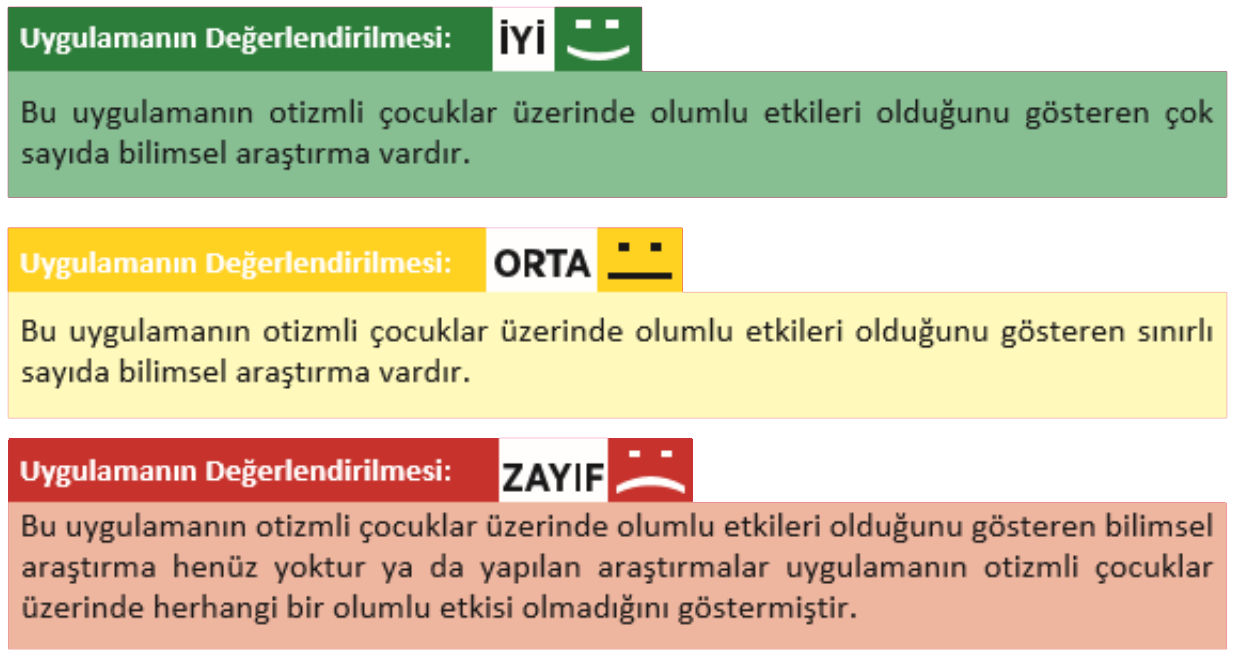
Aşağıda gösterilen terapi uygulamalarının otizmli çocuklar üzerinde olumlu etkileri olduğunu gösteren bilimsel araştırmalar henüz yoktur ya da yapılan araştırmalar bu uygulamanın otizmli çocuklar üzerinde herhangi bir olumlu etkisi olmadığını göstermektedir.
Etkisi zayıf terapiler hakkında daha detaylı bilgi almak için Otizm Spektrum Bozukluğunda Eğitim, Terapi ve Tedavi Uygulamaları – Öğretmenler ve Uzmanlar için Başucu Rehberimizi Please review.
- Açıkhava Etkinlikleri
- Akupunktur
- Dans & Hareket Terapisi
- Drama
- Duyusal Diyet
- Hayvan Aracılı Uygulamalar
- Hipnoterapi
- İşitsel Bütünleştirme Terapisi
- Bernard
- Tomatis
- FastForward
- Binaural Beat
- SAS
- Kraniosakral Terapi
- Kucaklama Terapisi
- Masaj
- Müzik Terapisi
- NöroPLAY
- Oyun Terapisi
- Prizma Gözlükle
- Sanat Terapisi
- Yoga
Source Recommendations:
- Brondino, N., Fusar-Poli, L., Rocchetti, M., Provenzani, U., Barale, F., & Politi, P. (2015). Complementary and alternative therapies for autism spectrum disorder. Evidence-Based Complementary and Alternative Medicine, 2015(1), 258589. http://dx.doi.org/10.1155/2015/258589
- National Autism Center. (2015). Findings and conclusions: National standards project, phase 2. Randolph, MA: Author
- Steinbrenner, J. R., Hume, K., Odom, S. L., Morin, K. L., Nowell, S. W., Tomaszewski, B., Szendrey, S., McIntyre, N. S., Yücesoy-Özkan, S., & Savage, M. N. (2020). Evidence-based practices for children, youth, and young adults with Autism. The University of North Carolina at Chapel Hill, Frank Porter Graham Child Development Institute, National Clearinghouse on Autism Evidence and Practice Review Team.
- https://asatonline.org/for-parents/learn-more-about-specific-treatments/treatments-in-alphabetical-order/

Psikiyatrik Tedavi Uygulamaları
Alternatif ve Destekleyici Tedavi Uygulamaları
Derin Beyin Uyarımı
Derin Beyin Uyarımı (Deep Brain Stimulation – DBS), nörolojik ya da bazı psikiyatrik hastalıkların tedavisinde tercih edilmekte; cerrahi yöntemlerle yerleştirilen elektrotlar aracılığıyla beynin belirli bölgelerine elektriksel uyarılar gönderilmektedir. Başta Parkinson hastalığı, titreme ve distoni olmak üzere; epilepsi, tedaviye dirençli depresyon, obsesif kompulsif bozukluk ve Tourette sendromunun ileri vakalarında kullanılan etkili bir tedavi yöntemidir. 2024 yılında Herrera‐Pino ve arkadaşları tarafından yapılan bir çalışmada, otizm ve ileri derecede zihin yetersizliği tanısı almış çocuk ve ergenlerde görülen saldırgan ve kendine zarar verici davranışların tedavisinde DBS uygulamalarının etkililiği ve güvenilirliği incelendi. Veriler DBS’nin bu grupta saldırganlık belirtilerinin sıklığında ve şiddetinde anlamlı bir azalma sağladığını gösterdi. Ayrıca sosyal işlevsellik, uyumsal davranışlar ve genel klinik iyilik hâlinde de iyileşmeler bildirildi. Benzer biçimde, Gorodetsky ve arkadaşları tarafından yürütülen başka bir çalışmada; tedaviye dirençli, kendine zarar verme davranışı gösteren ve otizm tanısı almış 7–14 yaş arası altı çocukta, saldırganlık sıklığı ve şiddetinde %30’dan fazla azalma ile birlikte yaşam kalitesinde belirgin artış gözlendi. Bulgular, DBS’nin ciddi kendine zarar verme davranışı gösteren çocuklar için umut vadeden bir tedavi seçeneği olabileceğini ortaya koymakta; ancak bu konuda daha geniş ölçekli ve kontrollü çalışmalara gereksinim olduğunu da vurgulamaktadır. Öte yandan, otizmde görülen problem davranışların beyindeki kesin kaynakları henüz net olarak belirlenmediğinden, uzmanlar bazı önemli hatırlatmalarda bulunmaktadır.
- DBS, yalnızca çok ciddi ve kronikleşmiş davranış sorunlarına sahip, geleneksel ve farmakolojik tedavilere yanıt vermeyen bireylerde değerlendirilmelidir.
- Bireyin mutlaka multidisipliner bir ekip tarafından ele alınması; müdahalenin, DBS alanında deneyimli uzmanların bulunduğu ileri düzey merkezlerde gerçekleştirilmesi ve uygulamanın sonrasında düzenli izleme ve takip çalışmalarının yapılması gerekmektedir.
Source Recommendations:
- Gorodetsky, C., Mithani, K., Breitbart, S., Yan, H., Zhang, K., Gouveia, F. V., Warsi, N., Suresh, H., Wong, S. M., Huber, J., Kerr, E. N., Kulkarni, A. V., Taylor, M. J., P Hagopian, L., Fasano, A., & Ibrahim, G. M. (2025). Deep Brain Stimulation of the Nucleus Accumbens for Severe Self-Injurious Behavior in Children: A Phase I Pilot Trial. Biological Psychiatry, 97(12), 1116–1126. https://doi.org/10.1016/j.biopsych.2024.12.001
- Herrera-Pino, J., Benedetti-Isaac, J., Ripoll-Córdoba, D., Camargo, L., Castillo-Tamara, E. E., MoralesAsencio, B., … & López, N. (2024). Effectiveness of deep brain stimulation on refractory aggression in pediatric patients with autism and severe intellectual disability: Meta-analytic review. BMC Pediatrics, 24(1), 487. https://doi.org/10.1186/s12887-024-04920-x
Transkranial Manyetik Uyarım
Transkraniyal Manyetik Uyarım (Transcranial Magnetic Stimulation – TMS), beyne dışarıdan herhangi bir elektrik akımı verilmeden manyetik alan oluşturularak, beynin doğal elektriksel aktivitesinin düzenlenmesini amaçlayan bir tedavidir. Bu tedaviyle, beynin düzensiz elektriksel aktivitelerinin dengelenerek bazı hastalıkların tedavisine katkı sağlayabileceği düşünülmektedir. TMS’nin otizm üzerindeki etkileri konusunda araştırmalar devam etmekte ancak yavaş ilerlemektedir. Smith ve meslektaşları 2023 yılında yaptıkları çalışmada TMS’nin otizmli bireylere uygulandığı 12 araştırmayı incelediler. Çalışma bu tedavinin özellikle tekrarlı davranışlar ve bilişsel zorluklar gibi otizm belirtilerini azalttığını, sosyal iletişim ve etkileşim becerileri üzerinde henüz bir etkisi olmadığını gösterdi. Uygulamanın otizmin tedavisine ilişkin umut verici olduğu, ancak daha güçlü çalışmalara gereksinim duyulduğu vurgulanmaktadır. Sonuç olarak, TMS’nin otizm tedavisindeki rolünü netleştirmek için daha fazla araştırma gerekmektedir.
Source Recommendations:
- Smith, J. R., DiSalvo, M., Green, A., Ceranoglu, T. A., Anteraper, S. A., Croarkin, P., & Joshi, G. (2023). Treatment response of transcranial magnetic stimulation in intellectually capable youth and young adults with autism spectrum disorder: A systematic review and meta-analysis. Neuropsychology Review, 33(4), 834-855. DOI:10.1007/s11065-022-09564-1.
Sağlıklı Beslenme
Etkisi Zayıf Tedaviler
Aşağıda gösterilen tedavi uygulamalarının otizmli çocuklar üzerinde olumlu etkileri olduğunu gösteren bilimsel araştırmalar henüz yoktur ya da yapılan araştırmalar bu uygulamanın otizmli çocuklar üzerinde herhangi bir olumlu etkisi olmadığını göstermektedir.
Etkisi zayıf tedaviler hakkında daha detaylı bilgi almak için Otizm Spektrum Bozukluğunda Eğitim, Terapi ve Tedavi Uygulamaları – Öğretmenler ve Uzmanlar için Başucu Rehberimizi Please review.
- Ağır Metallerden Arındırma
- Balık Yağı
- Çamaşır Suyu Terapisi
- DAN! Protokolü
- Diyete Besin Dışı Katkılar Ekleme
- Çeşitli Aminoasitler
- Prebiyotik
- Probiyotik
- Eliminasyon Diyetleri
- Deve sütü
- GAPS diyeti
- Glüten-Kazein diyeti
- FODMAP diyeti (Fermente Olabilir Oligosakaritler, Disakaritler, Monosakaritler ve Poliol)
- Ketojenik beslenme
- Peynir altı suyu
- Süt ürünlerinin çıkarılması
- Hiperbarik Oksijen Tedavisi
- Homeopati
- İntravenöz İmmunglobulin Tedavisi
- Kayropraktik Bakım
- Kök Hücre Tedavisi
- Mantar Tedavisi
- Marihuana Tedavisi
- Mıknatıslar
- Nörofeedback Temelli Tedaviler
- Nöro-Modülasyon
- Oksitosin Tedavisi
- Ozon Tedavisi
- Sekretin Tedavisi
- Şelasyon Tedavisi
- Transkutanöz Vagus Sinir Stimülasyonu (tVNS)
- Vitamin ve Takviye Desteği
- Yağlar
- Esans yağlar
- Kenevir yağı
*DİKKAT! Bu uygulamalar çocuğun sağlığı için riskli olabilir.
Source Recommendations:
- Fuentes, J., Hervás, A., Howlin, P., & (ESCAP ASD Working Party). (2021). ESCAP practice guidance for autism: a summary of evidence-based recommendations for diagnosis and treatment. European Child & Adolescent Psychiatry, 30(6), 961-984. https://doi.org/10.1007/s00787-020-01587-4
- Levy, S. E., & Hyman, S. L. (2015). Complementary and alternative medicine treatments for children with autism spectrum disorders. Child and Adolescent Psychiatric Clinics of North America, 24(1), 117-143.
- National Autism Center. (2015). Findings and conclusions: National standards project, phase 2. Randolph, MA: Author
- Steinbrenner, J. R., Hume, K., Odom, S. L., Morin, K. L., Nowell, S. W., Tomaszewski, B., Szendrey, S., McIntyre, N. S., Yücesoy-Özkan, S., & Savage, M. N. (2020). Evidence-based practices for children, youth, and young adults with Autism. The University of North Carolina at Chapel Hill, Frank Porter Graham Child Development Institute, National Clearinghouse on Autism Evidence and Practice Review Team.
- T.C. Sağlık Bakanlığı Sağlık Hizmetleri Genel Müdürlüğü (2022). Otizm Spektrum Bozukluğu Aile Rehberi. Ankara.
- https://asatonline.org/for-parents/learn-more-about-specific-treatments/treatments-in-alphabetical-order/